The Phases + Nutrients of
Organizer Growth

A black and white image of four multi-racial fists raised in the air.

Organizers are the key to lasting power building, but what organizers do and how they learned to do it is not well understood. To rebuild the ranks of organizers, the field and its funders need a deeper understanding of what it takes to grow, nourish, and sustain organizers.

The Organizer Learning Project engaged with over 75 organizers from across the country to explore the process of becoming an organizer. Their stories illuminated how and what they learned, the relationships and experiences that shaped them, and the evolution of their growth. The Phases and Nutrients of Organizer Growth that emerged from their stories point to opportunities for intervention and investment to strengthen the development of organizers.

Jump to Nutrients Jump to Resources
Phases of Organizer Growth

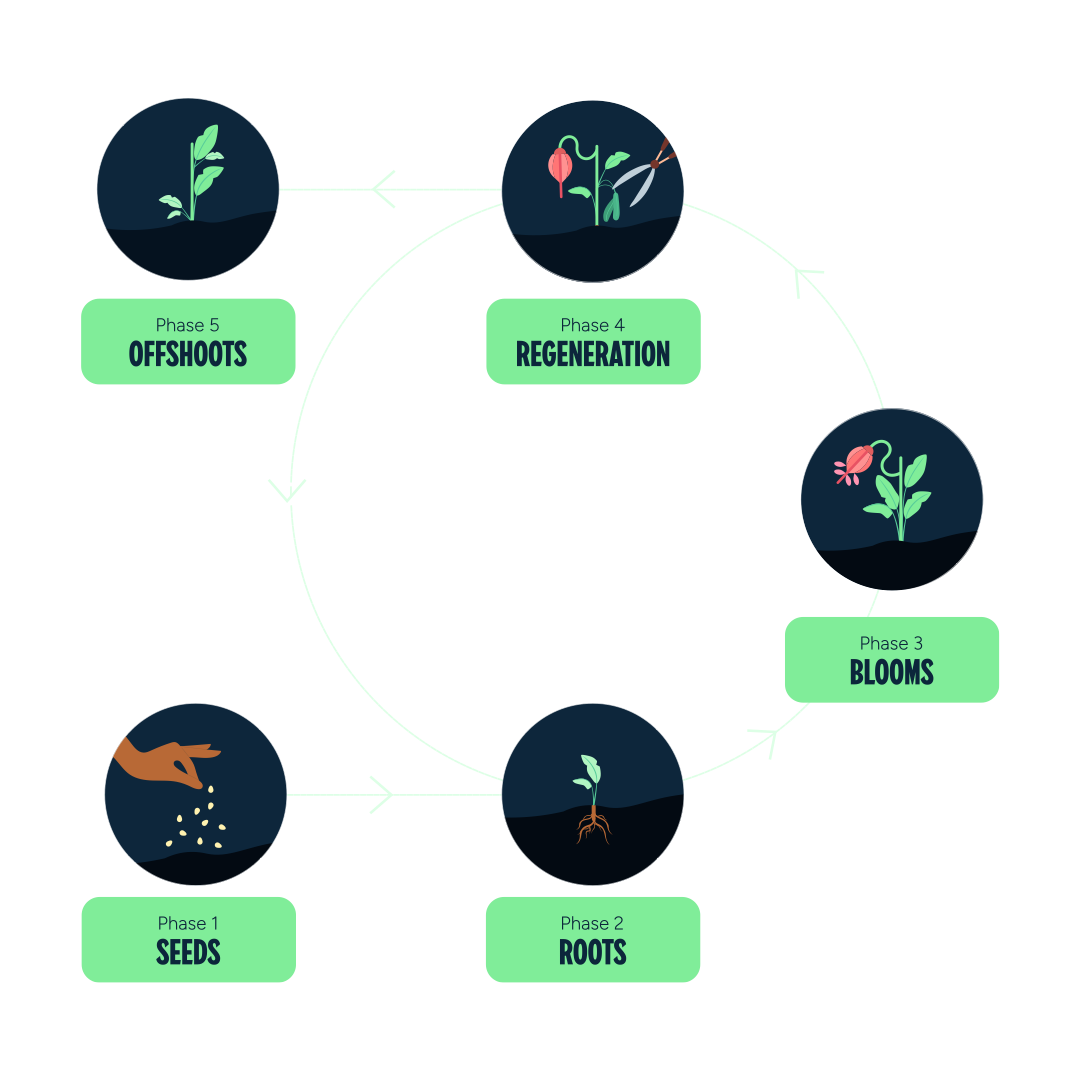
The five Phases of Organizer Growth uses imagery of perennial plants to illustrate the evolving, ongoing, and dynamic nature of organizer development. The stories and experiences organizers shared with us demonstrate that there is universality to the arc of growth, no matter their context or organizing tradition.

Five graphics are depicted in a cycle with labels. “Phase 1: Seeds”. A medium skin hand sprinkling seeds. “Phase 2: Roots”. A small plant germinating. “Phase 3: Blooms”. A larger plant flowering. “Phase 4: Regeneration”. Garden sheers cutting part of the flowering plant. “Phase 5: Offshoots”. The plant standing with no flowers.

Scroll to experience the phases.

Phase 1
Seeds

A graphic depicting a medium skin hand sprinkling seeds onto the ground.

This phase is an entry-point where a future organizer first sees the value and potential of organizing. For many organizers “seeds” are first-hand experiences participating in or observing a collective action or organizing effort.

They are invited into a moment by family, friends, mentors, or community members where they witness the power of organizing. These moments spark their curiosity about organizing and when they choose to pursue an organizing career.

A black and white image of the backs of a crowd of protesters, holding signs, with some holding their hands up in the air and clapping.

Seeing what people power looks like, what strength in numbers means, was really eye-opening for me. I remember seeing hundreds and hundreds of people outside City Hall... And seeing what solidarity looked like, I still remember to this day, it was such an inspiring moment for me as a young person.

Phase 2
Roots

A graphic of a small plant germinating, with its roots shown growing underground.

In this phase, organizers get their first taste of organizing and start developing the fundamental skills and relationships that will provide the groundwork for their career.

Through trainings, on-the-ground experiences, and one-to-one coaching and mentoring, organizers learn the day to day work of an organizer, gain awareness of their own self-interest and story, and develop relationships with community members, peers, mentors, and supervisors. The learning curve is steep, and organizers describe their experience of this phase as “drinking out of a fire hose.”

A black and white image of a young, dark skin woman sitting on a bench and talking, gesturing with her hand, while a young, dark skin man sits next to her on the bench, listening.

My first supervisor handed me this manual and was like, ‘Read the whole thing and then go find 10 people to talk to about what they care about in the community.’ I was 21 and I was so scared…That's how I learned how to organize. He pushed me into the deep end of the pool and was like, ‘Have 10 conversations and then call me. And we're gonna talk about what it means to be an organizer in the context of those conversations.’

Phase 3
Blooms

A graphic of a plant growing from out of the ground, with green leaves and a large pink flower.

The Blooms phase is when organizers thrive. They have a deep well of skills, relationships, and experiences and approach organizing with increased autonomy and confidence. In this phase, organizers know—and have experienced—what it takes to build and wield power.

As their experience and craft matures in this phase, organizers grow in three key ways:

  • Honing their distinctive approach to organizing.

  • Stepping into new leadership supervising and training other organizers, running campaigns, or taking on organization management.

  • Developing their ability to intuit and assess opportunities, threats, and context and experiment with new approaches and tactics.

In the Blooms phase organizers see their experiences, skills, and relationship-building come to fruition. They have seen what works and does not. They envision bolder campaigns, experiment with and adapt methods to strengthen their approach, and have more curiosity and openness about others’ work and what it can teach them in theirs. They are no longer just observing the power and potential of organizing—they are making it happen themselves.

A black and white image of a group of multi-racial and multi-generational people sitting in a circle of chairs, talking and smiling with each other.

This was at the height of my career when I had started to really move things that felt more aligned with what I wanted to do. It was during that time that I was able to really hone how I would move leaders and develop them around something that they really cared about. This is the point at which I learned a lot about myself and organizing and perfecting the craft.

Phase 4
Regeneration

A graphic of a flowering plant growing from the ground with a pair of garden shears open and angled toward the plant.

This phase is a pivot point for organizers when they experience a disturbance in their career and are unsure about their future in organizing. Organizers describe feeling bored, directionless, or burnt out in this phase. These feelings may be catalyzed by a specific event such as a campaign loss or staff turnover or an emerging awakening or observation about the field or themselves that has grown over time.

Some organizers leave the field at this point, while others come through this phase recommitted to organizing. Organizers who recommitted had experiences that gave them a new perspective, inspired them, and reminded them why they love organizing. These experiences allow organizers to step away from their organization or community for a period of time, returning reinvigorated and ready to re-engage in the work.

A black and white image of a young light skin man straddling two rocks on top of a mountain, with the views of a mountain range behind him.

10 years into my organizing, I was having a really rough time. I didn't know if I wanted to do this anymore…I went to organize in another region for 14 months and worked as the lead organizer. Being away from everything familiar helped me to just remember myself and remember the essentials of this work…I needed to step out of my context and see myself and the work differently. And the fact that I had people who had more experience than I did and had some imagination for me, was really critical. That was a pivotal moment for me.

Phase 5
Offshoots

A graphic of a green plant growing from the ground.

Organizers in this phase move away or fully step back from the day-to-day practice of organizing. Some organizers have reached the end of their careers and are ready to retire. Others remain committed to organizing, but shift to supportive positions in adjacent fields where they provide mentoring, training, funding, consulting, and thought leadership to the organizing field.

Some organizers at this phase become “sages” in the organizing field.  They have attained insight and wisdom through their organizing experience and reflection, and others look to them for guidance, advice, encouragement, and support.

Nutrients OF ORGANIZER GROWTH

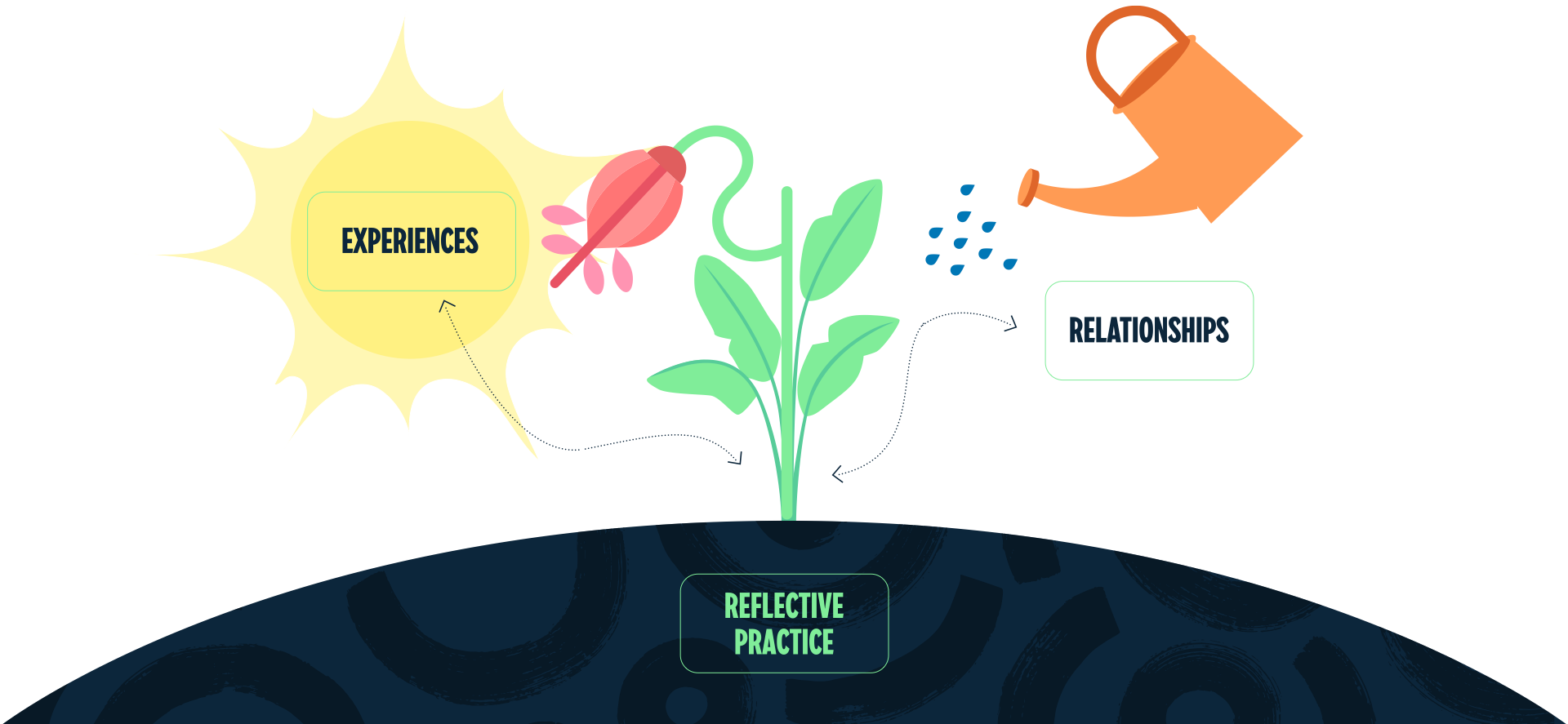
Like plants that need sunlight, water, and healthy soil to grow and flourish, experiences and relationships are the essential nutrients that propel organizers through the phases and support them to learn about the discipline, themselves, and the world around them. Experiences and relationships support, challenge, strengthen, and guide organizers.

A graphic showing the Nutrients of Organizer Growth. A large sun, labeled “Experiences”, and an orange watering can, labeled “Relationships”, come together through “Reflective Practice” to provide the nutrients for a flowering plant with green leaves and a pink flower growing from the ground.

Scroll to experience the nutrients.

Experiences

Training: Learning Organizing Skills

The trainings from the very first bootcamp training I went to as a member to week-long, to training the core content and reflecting on what that looked like in practice, I think has been really essential in learning the craft of the tools that we’re using.

A black and white image of a group of four dark skin young people talking with each other while sitting at a table with notebooks and a laptop open.

Shadowing: Seeing Organizing in Action

When I started organizing, I wasn’t really sure what I was doing, right? For me, it was really important to see people that I thought were experts doing the work and showing me the possibilities. It helped inform my style of organizing and facilitation. It also helped me get out of that imposter syndrome a little bit.

A black and white image of a group of multi-racial and multi-generational people sitting in a circle, holding coffee and notepads and talking with each other.

Doing: Practicing + Developing the Discipline

We learn by doing, right? Many of us, we learned by taking action and getting involved… there’s no master’s in organizing, but there are certain things that, through the experience that we engage in a daily basis, we continually glean more, and we develop that knowledge base or that experience to be able to bring about the change in communities.

A black and white image of a young medium skin man wearing a keffiyeh standing and talking into a microphone that he is holding.

Sensing: Reading + Translating the External Context

It is knowing the knowledge of the base you are trying to do your work in. That is knowing the people, knowing the turf, knowing the power brokers in the turf and some of the folks who have influence.

A black and white image of two dark skin people in suits shaking hands and standing in front of a government building.

Journeying: Having New Organizing Experiences to Reset + Reinspire

You can’t stay in the same organization, same location for a long time and grow as rapidly as you can. In Greek mythology, people would go out, they hear the call to the sea, an adventure, and they don’t know whether they can do the thing. And then they go out and then they do the thing and then they come back transformed. People need those experiences.

A black and white image of three young women sitting on the ground and using markers and paints to create protest signs.

RELATIONSHIPS

Supervisors: Providing Guidance + Tools

Supervisors are senior or lead organizers, organizing directors, or executive directors who provide regular oversight and professional guidance on organizing skills, strategies, campaigns, and goals. “The unique contribution of supervisors is that these folks get to see you on a regular basis, so they start to really understand your strengths and call those out, as well as start to see the patterns of weaknesses.”

A black and white image of two women looking down and pointing at an open book.

Mentors + Coaches: Supporting Individual Growth

Mentors and coaches are often individuals outside of the organizer’s organization who do not have a formal oversight role of the organizer but play an influential role in organizers’ personal and professional growth. Mentors help organizers forge their own path as an organizer, reminding them to care for themselves, encouraging them to take the long view of their personal and professional growth, and helping them answer the “bigger questions” about their place in the field and in their community.

A black and white image of two women with afros standing and smiling as they look at each other.

Peers: Facilitating Truth-telling + Accountability

Peers are in a similar phase of their development which allows organizers to “think together” and share in the struggles, challenges, and victories. Peers help organizers feel less alone and normalize how difficult the work is. “I feel like peers are very helpful in signaling and letting you know to trust your gut and it feels easier to gut check with peers than it does sometimes with the supervisors and mentors.”

A black and white image of a group of men sitting in a close circle talking to one another.

Community Leaders + Members: Ground-Truthing

Community leaders and members humanize organizing work and make it real. They are the external reality check that cuts through intellectualization and professionalization. “I listen a lot to what the community has to say because they show up as leaders and make me feel really grounded.”

A black and white image of three men wearing suits standing and talking with each other.
A graphic of a plant with green leaves and a pink flower growing from the ground.

REFLECTIVE PRACTICE

Where relationships + experiences come together

Organizer growth is nurtured at the intersection of relationships and experiences. Powerful learning happens when experiences and relationships come together in moments of formal and informal reflection with mentors, peers, community members, or supervisors. Reflective practice enables organizers to metabolize their experiences, discern lessons, and shape future action.

When navigating experiences alone, organizers express feeling doubt, isolation, and loneliness. When organizers have space and relationships to reflect on their experiences in connection with others, it fosters learning and confidence. Reflective practice is a critical pathway for organizer growth.